Three Companies, One Molecule: An updated thesis on Aduro Clean Technologies - August, 2026
Aduro is shifting from a chemistry story to an execution story. A look at its plastics, heavy-oil, and renewable-oils opportunities, the case for a high-margin licensing model, recent milestones, valuation scenarios, and the developments that could drive the next stage of commercialization.
Disclosure: I am a shareholder of Aduro Clean Technologies Inc. and hold a long position. I receive no compensation from the Company for this or any other publication. Nothing below is investment advice; it is my own analysis, and I may be wrong. Do your own work.
The setup
Eighteen months ago, the argument for Aduro was almost entirely a chemistry argument. You had to believe that a small team in London, Ontario had found something real, a water-assisted, low-temperature route to breaking hydrocarbon bonds that the majors had somehow walked past for seventy-five years, and then you had to believe they could build it.
That is no longer the shape of the trade. Between March and August of this year, the story quietly stopped being about whether the chemistry works and started being about whether the company can execute an industrial project on schedule. That is a different risk, priced differently, and it is why two sell-side firms initiated coverage within eight days of each other in late July and early August.
The stock closed at $15.43 on August 26, with a market cap of roughly $544 million and 33.7 million shares outstanding. The 52-week range is $9.00 to $18.19. The company carries no debt, has roughly US$40 million after the last two financings, and burns about C$10 million annually; insiders still own about 34%.
What follows is the thesis as I hold it today, framed the way I have always framed it: not as one company, but as three sitting under a single patent umbrella, plus a fourth that nobody is paying for.
The umbrella
Everything Aduro does runs off one observation. Put a hydrocarbon in water at moderate temperature with an inexpensive catalyst and a cheap hydrogen donor, glycerol, ethanol, a few percent by weight — and you can cleave large molecules into smaller, useful ones selectively, without external hydrogen and without the brute force of thermal cracking.
Two consequences follow, and they drive the investment case.
First, yield. Hydrochemolytic Technology converts up to ~90% of the carbon in polyolefin waste into steam-cracker-ready feedstock. Pyrolysis, the incumbent route used by nearly every competitor, lands closer to 70%. Under EU mass-balance accounting, only the fraction destined for new plastic earns recycled-content credit, so the creditable output gap is wider than the raw-yield gap suggests.
Second, and more important, what you skip. Pyrolysis oil is olefinic. It cannot enter a steam cracker without hydrotreatment, high pressure, high temperature, expensive catalyst, and purchased hydrogen. Peer-reviewed work this year puts that step at $400 to $1,200 per tonne depending on geography. It is effectively a second factory bolted onto the first. HCT produces a predominantly paraffinic, low-olefin oil that goes in as-is.
Remove the second factory and a chain of dominoes falls. Operating cost drops. Capital intensity drops. Minimum economic plant size drops from the 100,000–200,000 tonne/year threshold pyrolysis needs to roughly 25,000 tonnes, a quarter the size. Which means you can site plants near feedstock instead of hauling feedstock to a mega-plant, deploy a unit in under a year, and copy-paste capacity rather than betting the company on one enormous build.
That is the platform. Now the three businesses.
Company one: plastics upcycling (HPU)
This is the vertical closest to revenue and the one carrying the near-term milestones.
The proof point landed on June 9: the 10 kg/hr Next Generation Process pilot in London ran 47 continuous hours on recovered polypropylene at 86% liquid hydrocarbon yield. That is the first public empirical validation of the yield claim under sustained continuous operation rather than batch conditions. It matters less as a number than as a category change — the machine turns on, stays on, and does what the deck said.
From there, 2026 has been a steady sequence of gating risks getting retired:
- June 17 — Ortessa Groep MOU. A Dutch waste operator to plan feedstock logistics into Chemelot. Unglamorous and easy to skip past, but a chemical recycler without a feedstock chain is a science project.
- June 30 — AstroTurf MOU. Evaluating HCT on end-of-life synthetic turf, recovering the PE and PP embedded in polyurethane backing, infill, sand and field grit. Turf is a genuinely nasty multi-material waste stream with essentially no competition, and New York State's EPR carpet framework is starting to force the issue.
- July 16 — ECOCE Phase 1 complete. Mexican post-consumer flexible packaging mapped; the collaboration moves to actual HCT testing. Mexico has ~132 million people, no domestic chemical recycling infrastructure, and a short logistics hop to US Gulf Coast petrochemical buyers.
- August 19 — Saipem selected. Engineering and procurement support for the first-of-a-kind facility at Chemelot. Initial scope covers Process Design Package review, optimization of critical equipment packages, preliminary utility integration and capital cost refinement, with stage gates that open into FEED, detailed engineering, procurement, construction and start-up. Early works are funded from existing cash; no raise attached.
That last one is the most consequential item of the year, and I think it is being under-read. Saipem is a tier-one industrial contractor. Handing them the process package and letting them tear into the capex estimate is what a company does when it intends to reach FID, not when it intends to keep issuing press releases. Note that Aduro has not said whether Saipem is the same "leading global EPC firm" behind the March licensing-package MOU; the company has kept that counterparty unnamed, and I am not going to assume they are one and the same.
The FOAK itself: ~1,000 kg/hr, roughly 10,000 tonnes a year, at Chemelot Industrial Park in Sittard-Geleen. Mechanical completion is targeted for 2H27, commissioning for 2028, with a non-binding offtake LOI over the initial production parcel and a petrochemical customer literally a pipeline away.
Behind it sits the regulatory clock. The EU's PPWR recycled-content mandates begin binding in 2030. Mechanical recycling cannot supply polyolefin volumes at the required quality, particularly for food-contact applications that represent roughly half of polyolefin use. Meanwhile, several pyrolysis players have exited or scaled back over the past two to three years. The demand curve is legislated, and the credible supply set is getting thinner. That is an unusual combination.
Company two: logistically challenged crude
This is the vertical the market gives Aduro almost nothing for, and it is where the most interesting thing happened this summer.
The CEO's line is that paraffinic crude is essentially "liquid plastic", long saturated chains that solidify at ambient temperature. Same bond-scission problem, same chemistry, and because the feed arrives liquid at 50°C, you do not even need the front-end melt extruders the plastics configuration requires. Simpler reactor, capital-light second market.
On July 30, Aduro announced it had secured both yellow and black paraffinic crude from multiple Uinta Basin sources through engagement with the Utah Petroleum Association and regional producers, and had completed design, construction and testing of a dedicated lab-scale continuous-flow unit for the application. It also expanded the London headquarters by ~4,600 square feet and consolidated the Sarnia operations into it.
Read that carefully. Feedstock secured from multiple producers. Purpose-built continuous-flow hardware, separate from the plastics equipment. A dedicated program director. Facility expansion to house it. This is no longer a research line item; the company is in the later stages of Technology Demonstration and moving toward Process Development and Optimization.
The prize: the Uinta Basin produces around 200,000 bpd of waxy crude that today needs blanket-heated trucks and steam-heatable rail cars, with producers signalling growth toward ~500,000 bpd if someone solves the logistics. Solve the pour point, and you unlock pipeline access. A royalty on those barrels is high-margin revenue against essentially no incremental capital from Aduro.
Sitting alongside it is the original genesis application: bitumen upgrading. Alberta bitumen needs 25–30% condensate dilution to move through a pipe; diluent procurement runs into hundreds of millions annually for large producers, and Canadian condensate supply is structurally short. Cut the diluent requirement, and you create real per-barrel value for the producer. The upgrading step also strips nickel and vanadium, and vanadium has its own demand story in grid-scale flow batteries. Management has guided to bitumen announcements during 2026, and that remains outstanding.
Company three: renewable oils (HRU)
The least developed and the most ignored. Aduro classifies it at the "Advanced Research" stage.
Run vegetable oils, used cooking oils, corn distillers' oil, or animal fats through the HCT mechanism, and you get green diesel, saturated fatty acids, and BTX aromatics. The elegant part: this configuration needs no external hydrogen donor at all; the plant oil's own hydrogen stabilizes the reaction. Conventional hydrotreating for renewable diesel is high-pressure, high-temperature, expensive-catalyst, hydrogen-hungry chemistry. HCT is none of those things.
The output enables genuinely fossil-free base chemicals, 100% plant-derived PET and cosmetic ingredients, that carry a marketing premium well above the fuel value. Aduro cites a ~US$121 billion market by 2030, comparable in scale to the plastics opportunity.
I model nothing here and neither, sensibly, does the sell side. It is free optionality on a platform already paid for.
The fourth company nobody is paying for
Combine the plastics and bitumen chemistries, and you get a line of attack on cross-linked polyethylene and, potentially, vulcanized rubber. XLPE and tires are notoriously unrecyclable, and the competitive field is close to empty. The AstroTurf MOU is the first commercial expression of this; turf is exactly the kind of contaminated, multi-material, "too hard" stream conventional recyclers walk away from, and HCT was designed to tolerate.
Add carbon credits and critical metals recovery, and you have several revenue lines that appear in no analyst model I have seen.
Where the street is
I'll give you the targets and leave the model-building to the people paid for it.
Roth Capital initiated July 27 with a Buy and a $30 target, built off 2035 projected EBITDA discounted back and a modest premium to circular-economy comparables. Whilst I respect Roth, this model assumes Aduro will have one commercial plant by 2030, one licensing deal for 25,000 tons, and one small operation for Parrafinic Oil.
D. BBoral Capital: Initiated last year and revised their price target to 46$ per share. However, their model assigns zero value to anything outside of the plastic vertical.
Ladenburg Thalmann (Jon Hickman) carries roughly $24.75, up from $19, on a fiscal 2030 revenue model spanning one owned commercial plant, one licensed plant, and a modest 50,000 bpd of paraffinic crude that is all.
Water Tower Research initiated August 4 with a 44-page piece by Peter Gastreich titled "A Generational Step Change in Hydrocarbon Chemistry." WTR does not publish ratings or price targets by policy, but their long-run scenario carries EBITDA scaling into the hundreds of millions by FY31 and beyond that by the mid-2030s. It is the most thorough public document on this company and, if you read one thing, read that.
Consensus across the four analysts now covering the name sits near $30.87, roughly double the current price.
Two things worth noting about that. First, WTR is a compensated research provider, and Roth has done investment banking for Aduro; both disclose it plainly, and you should weigh accordingly. Second, and more usefully: every one of these models is a discounted 2030-and-beyond scenario. None of them are valuing the business in front of you. They are pricing the probability that a 10 kg/hr pilot becomes a 1,000 kg/hr plant becomes a licensing franchise.
The model worth reading
Which is exactly why the most useful valuation work I have seen on this name didn't come from a bank. It came from Peter
: who has built a full sum-of-the-parts model on Aduro and, more importantly, published it as a live tool rather than a conclusion.
Link to Peter's model:
https://claude.ai/code/artifact/6a798980-62cc-415d-a58c-5c05be4577c4
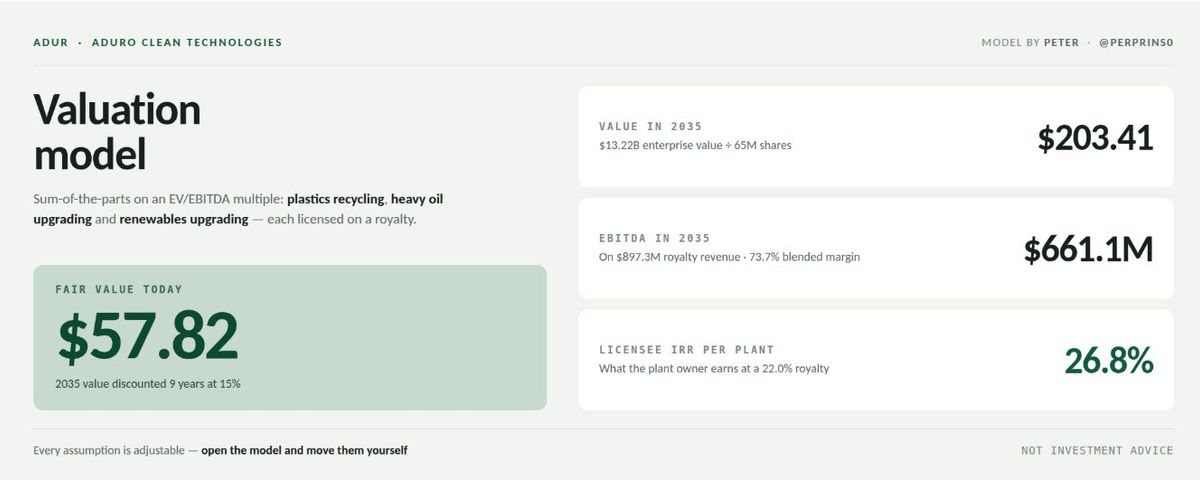
His framework treats the platform the way I have argued it should be treated: three separate businesses, plastics recycling, heavy oil upgrading, renewables upgrading, each valued on an EV/EBITDA multiple, each monetized as a royalty rather than as an owned-and-operated industrial asset. Here is where it lands.
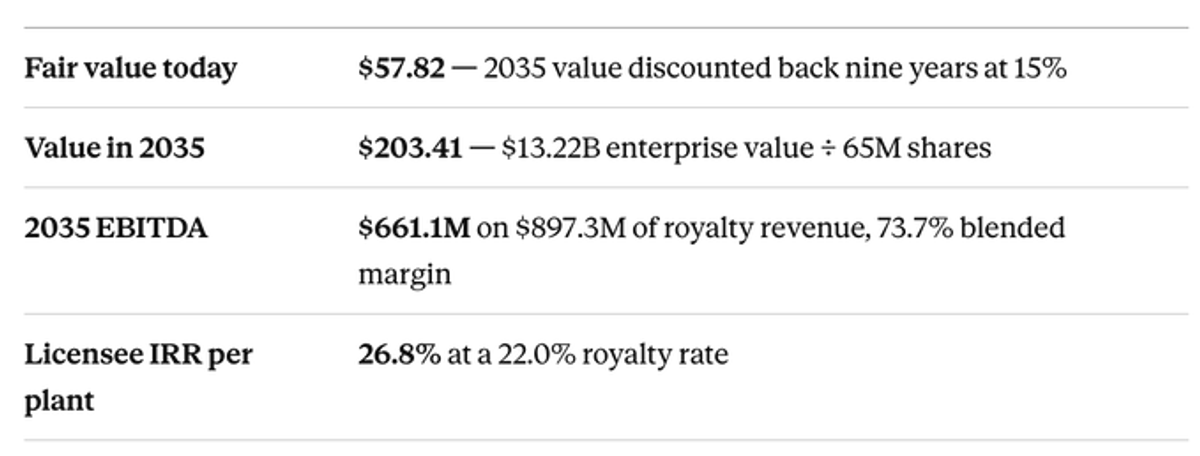
A note on the headline number, because it moves: Peter's snapshot was struck against a market price of $11.07, which produced the ~422% upside figure on the model's face. Against the August 26 close of $15.43 the same $57.82 fair value implies roughly 275%. Still a multiple of the current price, still a long way above the $24.75–$30 sell-side band — but quote it correctly if you repeat it.
Three things about this model deserve more attention than the fair value itself.
The royalty framing is right. Every sell-side model consolidates owned plants, which drags in construction capex, working capital, depreciation, and minority interests. Peter models what Aduro actually is if the licensing strategy works: a technology owner clipping a royalty on other people's capital. That is why the blended margin sits at 73.7% rather than the 45–55% gross margins you see in the plant-level models. It is a fundamentally different business to own.
The 26.8% licensee IRR is the load-bearing number, not the $57.82. This is the one I would interrogate first. A royalty business only exists if the counterparty makes money paying it. At a 22% royalty rate, a licensee still earns a high-20s IRR; if that holds, the licensing model sells itself, and the deployment curve depends on how fast Aduro can sign, not how fast it can build. If that IRR is really 12%, the whole capital-light thesis collapses back into a slow, capex-heavy build-and-operate story and the multiple compresses hard. Everything above rests on that one cell.
And it is honest about the share count. 65 million shares in 2035 against 33.7 million today; the model bakes in roughly a doubling of the share base. That is the dilution I discuss below, already in the number. It is not a model that pretends the buildout is free.
Go move the assumptions yourself, the model is live, and every input is adjustable:
https://claude.ai/code/artifact/6a798980-62cc-415d-a58c-5c05be4577c4
Pull the royalty rate down. Push commissioning out a year, which you probably should, given the permitting risk below. Zero out the renewables leg entirely and ask whether plastics and heavy oil alone carry the market cap. That is the entire point of publishing a machine instead of a target: a price target is something you either accept or ignore, whereas a model is something you can argue with in specifics.
Full credit to Peter for building it and putting it out in the open. Go follow him
This is a materially better contribution to the public understanding of this company than most of what gets published about it, mine included.
The bear case, honestly stated
I am long this. So let me be blunt about what breaks it.
Permitting at Chemelot is the gating risk, and management says so themselves. Chemelot is a complex multi-tenant industrial hub with multiple regulatory bodies involved in environmental, safety, and operational approvals, and Aduro depends on an external consultant to run that process. A permitting slip pushes 2H27 mechanical completion to the right, which pushes commissioning, which pushes every revenue line in every model above. This is the single most likely source of disappointment.
The scale step is real and unproven. 10 kg/hr to 1,000 kg/hr is a 100x jump. The June campaign de-risks the chemistry under continuous conditions; it does not de-risk industrial-scale heat transfer, solids handling, fouling behaviour over months rather than hours, or feedstock variability in post-consumer streams. Nobody has run HCT at commercial scale because commercial scale does not exist yet.
Dilution is coming but not this year, and that distinction matters. Roth's model assumes another $50–60 million of equity through 2030 to fund the buildout, and WTR concentrates the dilutive requirement in FY27–FY30. Those are real numbers, and they will show up eventually.
What they are not is an imminent overhang, and I see this consistently misread. Following the last two financings, Aduro is sitting on roughly US$40 million against an annual burn in the C$10 million range. The Saipem early works are explicitly funded from existing cash; the company said so in the release. That is multiple years of runway on operating spend alone, and it means management gets to time the next raise, not the balance sheet.
That is the whole point of the stated policy of raising only at progressively higher, milestone-linked valuations: it only works if you are never cornered. Four raises in eighteen months, each at a better level, is the track record, and the June round was struck into strength rather than out of necessity. So when you see "dilution risk" in a risk factor list, the question isn't whether, but from what price. A raise into a re-rated stock is a very different event from a rescue financing.
The honest caveat: "so far" is doing work in that sentence. FOAK construction capex is a step change from a C$10 million burn rate, and a bad tape at the wrong moment still changes the terms. Note that Peter's model already assumes the share count roughly doubles to 65 million by 2035, so the $57.82 above is a post-dilution number, not a pre-dilution one. That is the right way to carry it.
Circular naphtha pricing is a guess until 2030. The models lean on ~US$1,500/tonne against fossil naphtha at $650–700. The premium is real and driven by regulation, but nobody has a contracted price because the mandates aren't bound yet. Management says as much openly. If PPWR implementation slips or softens politically, the premium compresses and the economics change materially.
And the obvious one: this is a pre-revenue microcap with C$0.2 million of nine-month revenue, a C$14.4 million operating loss, and a valuation that is entirely a function of belief about 2030. Position size accordingly.
Bottom line
I still hold this because the risk profile has been changing in one direction all year. In March you were underwriting chemistry. Today you are underwriting a project schedule, with a tier-one contractor inside the data room, feedstock logistics contracted, an 86% yield demonstrated over a continuous run, a second vertical that just got its own hardware and its own crude supply, and a regulatory deadline that does not move.
What I am watching between now and the FOAK: visible progress on the Chemelot permit, the Delphi life-cycle assessment publication, the outcome of the TotalEnergies collaboration, conversion of the March offtake LOI into something binding, and the bitumen announcement management has guided to for this year. If any two of those land well, the de-risking curve steepens again.
The market is pricing one company. There are three and a half.
Long $ADUR. Not investment advice. Go build your own model, or start with Peter's.
This article reflects personal research and opinions and is provided for informational purposes only. It is not financial advice, a recommendation to buy or sell any security, or a consideration of your individual circumstances. Investing in small-cap and pre-commercialization companies involves significant risk, including the risk of total loss. Always do your own research and consider speaking with a qualified financial professional before making investment decisions.
Stay Informed with The Wire
Get the latest insights and analysis on public companies delivered directly to your inbox.