Brazil Is Waking Up. Credit Where It’s Due.
Long position in EWZ, EWZS, PBR and 26 Metals Inc. (CSE: IRON · OTCQB: PCRCF · WKN: A3D8AK)
Some charts you can stare at for an hour. Others you only need to see once. Tavi Costa at Crescat Capital put out two of the second kind this week, and they’re the reason this post exists.
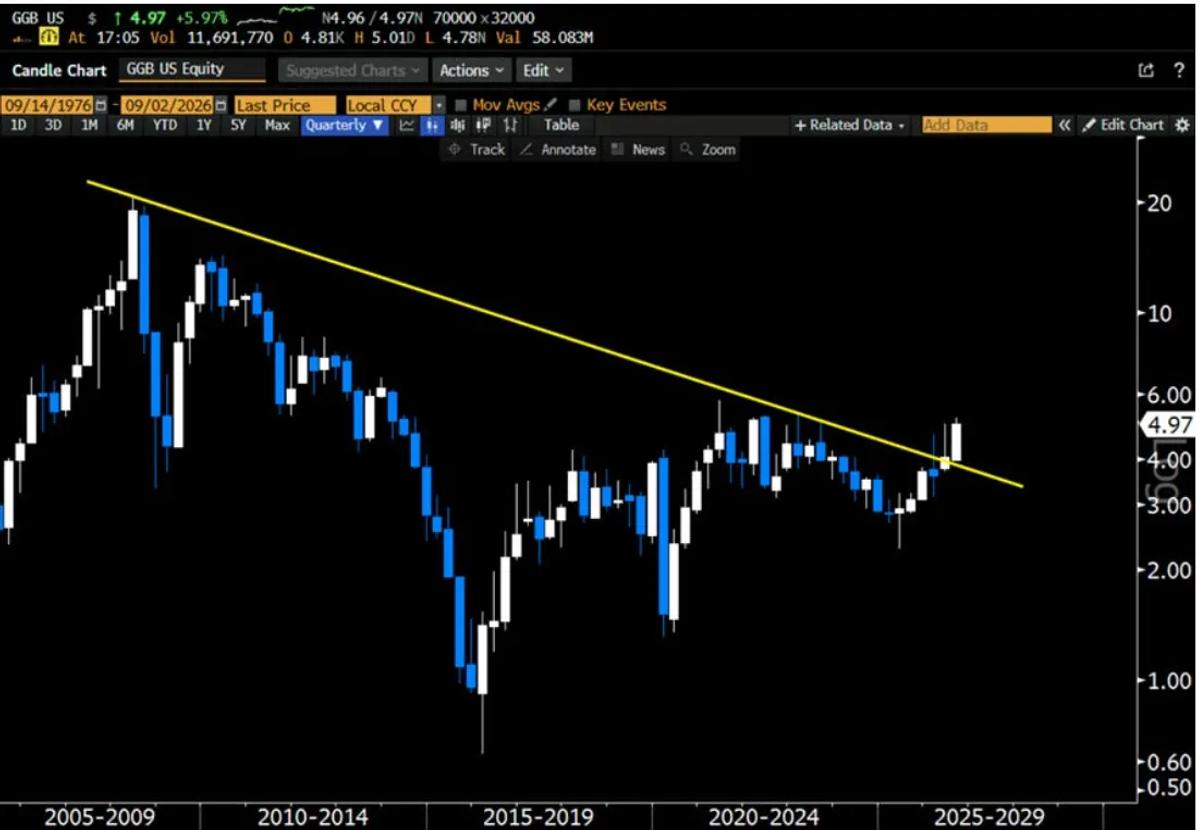
Gerdau (GGB US), quarterly. Source: Tavi Costa, Crescat Capital
That yellow line is the downtrend off Gerdau’s 2008 peak near US$20. It capped every rally for almost eighteen years. The current quarterly candle has pushed clean through it, printing US$4.97, up ~6% on 11.7M shares. Tavi calls Gerdau one of the world's most efficient steelmakers and reads the breakout as a leading indicator for the whole Brazil trade. I agree.
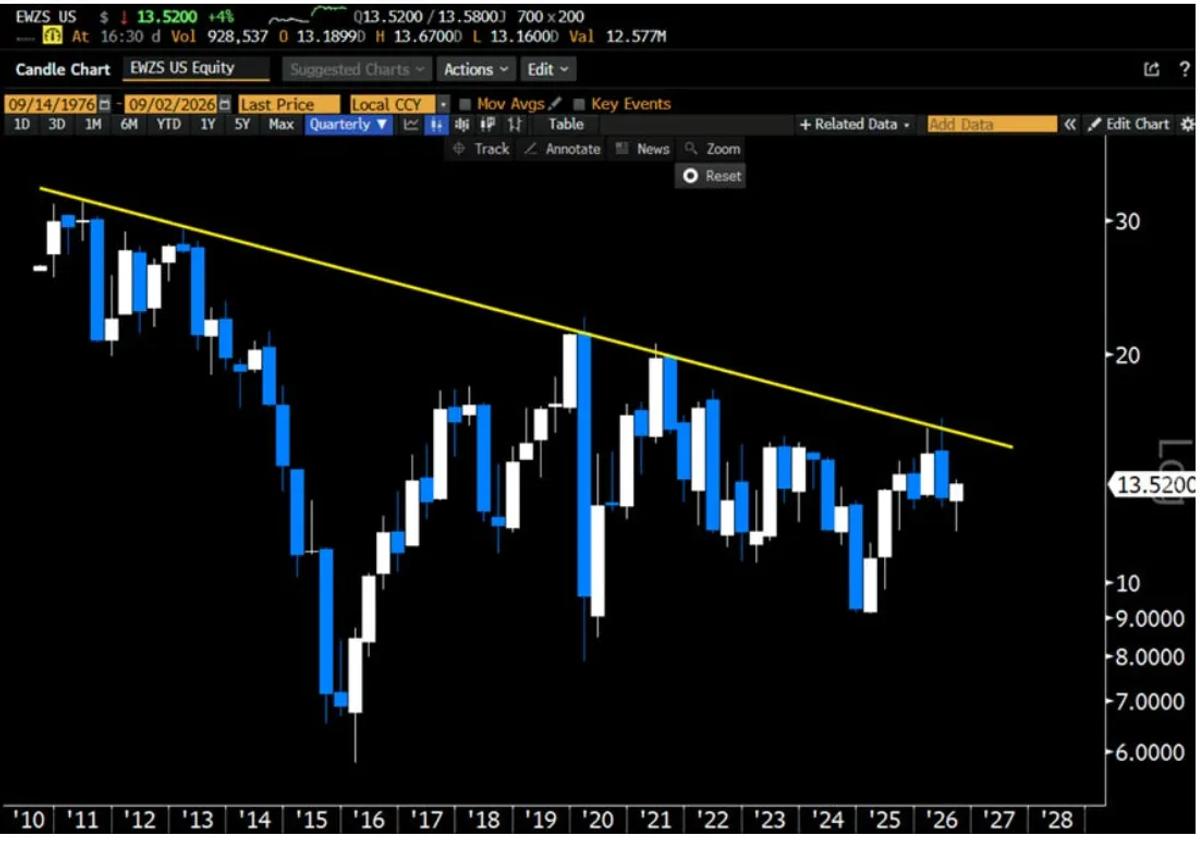
iShares MSCI Brazil Small-Cap (EWZS US), quarterly. Source: Tavi Costa, Crescat Capital
Now the second chart. Brazilian small caps are still pinned under their own downtrend, one that runs all the way back to 2011. EWZS sits at US$13.52, a few dollars shy of the line. No confirmation yet.
Tavi’s framing is the one I keep coming back to: the lag can be your friend. When the large caps break first and the small caps haven’t moved, the thesis strengthens while the cheapest part of the market still prices in the old regime.
His broader case, paraphrased and worth reading in full from him:
- Capital is welcome. While parts of the US push back on data-center construction, Brazil is opening the door. It already leads Latin America in existing and announced data centers, and it has spare power capacity to absorb new demand.
- The relative trade is being tested. Brazilian equities versus the S&P 500 are retesting the long-term trendline they broke earlier this year. That’s where conviction gets tested.
- The financial plumbing is re-rating. Brazilian banks and XP are his cleanest expressions of renewed capital flows and financialization.
- Let it run. He sees this as one of the defining macro trends of the decade, still early, and not worth trading swing by swing.
I’ve been positioned in Brazil through EWZ and Petrobras for a while, inside a framework built around dollar debasement and hard assets. Tavi’s work sharpened something I’d been circling: if the large-cap re-rating is underway, the asymmetry is in the small end of the market that hasn’t caught up. And if Gerdau is the signal, I want to own what goes into the steel.
From the Steel Mill to the Ground Under It
Gerdau breaking out tells you the market is starting to pay for Brazilian steel again. Steel starts as iron ore, and the densest concentration of steel mills and pig-iron plants in Brazil sits in one state: Minas Gerais, home of the Quadrilátero Ferrífero, the Iron Quadrangle.
That’s where this series starts. Deep Dive #1 is a company I own, with my own money, and am not paid to cover: 26 Metals Inc. (CSE: IRON · OTCQB: PCRCF · WKN: A3D8AK), formerly Bolt Metals.
The one-line pitch: a near-surface, free-dig hematite project in the Iron Quadrangle, targeting first production in H2 2027 on roughly US$12M of initial capital, with domestic buyers 34–47 km away by road. And it trades at about C$20M, priced like a grassroots explorer.
This is the small-cap lag Tavi talks about, compressed into a single ticker.
The Thesis: Florália
Florália is a friable, supergene-enriched hematite deposit 70 km east of Belo Horizonte. Weathering leached silica from the banded iron formation, leaving a soft, high-grade blanket at the surface. Soft enough that you dig it. No drilling, no blasting.
1. Scale
The company reports an Exploration Target of ~50–70 Mt of friable hematite, sitting on a larger ~130–170 Mt itabirite target. At ~60% mass recovery, the friable portion alone implies 30–42 Mt of product. Mineralisation is open along strike and at depth, backed by a large magnetic anomaly.
To be clear: that’s a conceptual target, not a resource. More on that in the risks.
2. It is not a magnetite project
This is the part most people miss. Magnetite starts at 25–35% Fe and needs grinding, flotation, a wet plant and a tailings dam. That’s billions of dollars and five to ten years. The company’s own reference point is Oceanic Iron’s 2020 PEA: US$1.19B in initial capital.
Florália crushes, screens, and does dry magnetic separation. Then it dries the biomass to ~3% moisture. That’s it.
- No wet plant.
- No tailings dam.
- No water permit required.
In Minas Gerais, that last trio matters more than anywhere on earth. This is Mariana in 2015 and Brumadinho in 2019. A project that never builds a tailings dam removes the single most politically sensitive item in Brazilian iron ore permitting.
3. Metallurgy: two dials on one ore
Dry magnetic testwork (Fundação Gorceix, Inbras, and a DMT Group conceptual study from April 2026) upgraded ~47–52% Fe feed to 62–68% Fe, an 8–17-point jump. The trade-off is mass recovery versus grade:
- ~60% mass recovery to a 61% Fe product. This is the planning case.
- ~71% recovery at a 57–58% Fe product.
- 77–80% recovery on feed grading 56% Fe and above.
- Best pilot fractions reached 69% Fe.
The product spec is where it gets interesting:
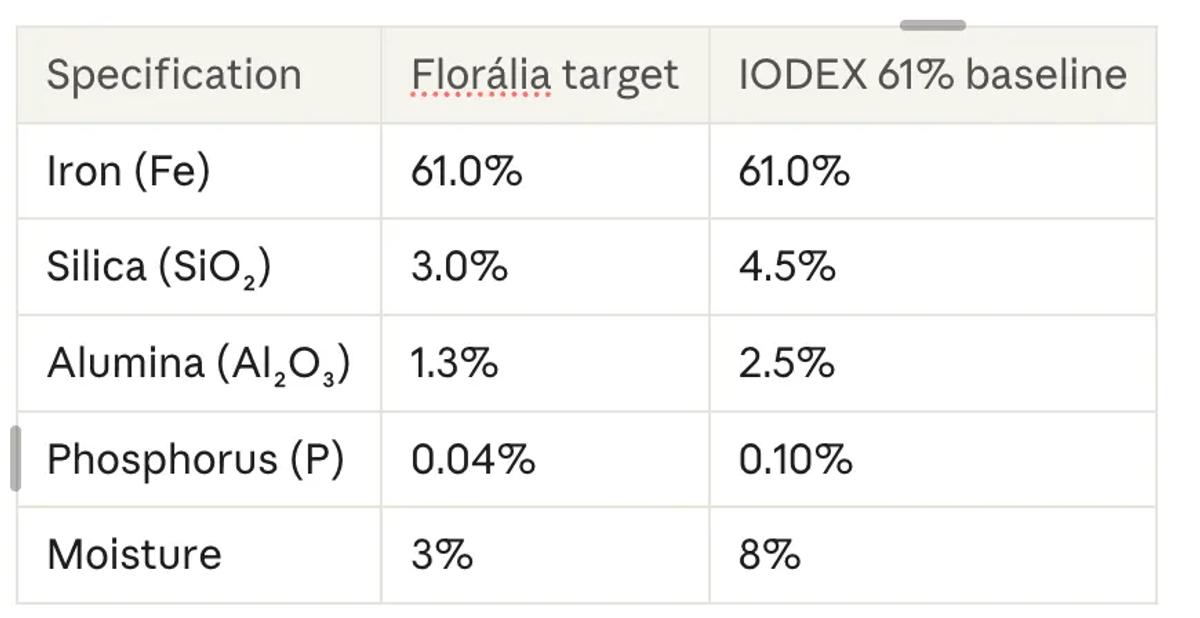
At benchmark on grade, below it on every penalty element. Note that Platts cut the benchmark from 62% to 61% Fe in January 2026 because seaborne supply quality keeps sliding. Clean ore is getting scarcer. Scarce things earn premiums.
4. The buyers are down the road
This is the commercial moat. Florália sits 34–47 km by road from Vale’s Brucutu and Água Limpa terminals, Avante, and ArcelorMittal’s Andrade operation. Minas Gerais has 9 of Brazil’s 31 steel mills, 43 merchant pig-iron plants producing ~75% of the country’s pig iron, and those buyers consume granular ore across a 55–64% Fe band. Florália’s product sits right inside it.
The company maps four sales channels: independent mills collecting at the mine gate (the main margin driver), regional spot buyers, a single large-volume offtaker, and seaborne export via a trader as the floor. Selling at the mill gate means no rail, no port, no ocean freight eating the margin.
5. Capex a micro-cap can actually fund
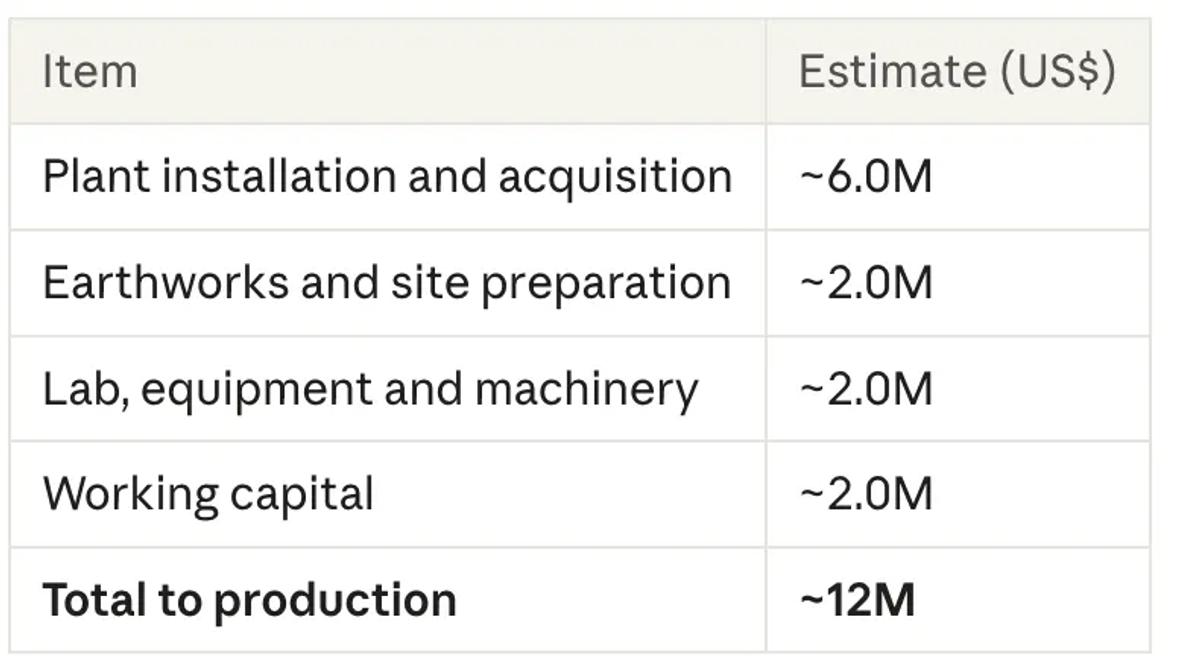
Phase I runs 1.5 Mtpa of run-of-mine for ~900 kt of product. That rate is a regulatory cap, not a ceiling. A conceptual Phase II takes it to 4.5 Mtpa with two more modular lines, conditional on resource growth, full EIA/RIMA permitting, and self-funding from Phase I.
The best real-world analogue in the deck is Fenix Resources’ Iron Ridge in Western Australia. Built for ~A$11.9M, it paid back its capital in under a year, while trucking ore 490 km to port at A$43.27/t in haulage alone. Florália’s haul is a tenth of that. To be fair, Iron Ridge ships higher-grade true DSO with no beneficiation. But the trucking gap is enormous.
To be clear, the Company will need to raise c. 9MUS to complete the above, as they are sitting at 4-5MCAD as of the latest financials. That could also come from the warrants that are currently deep in the money.
What You’re Paying, and What Assets Like This Fetch
The structure, read with a Big 4 lens
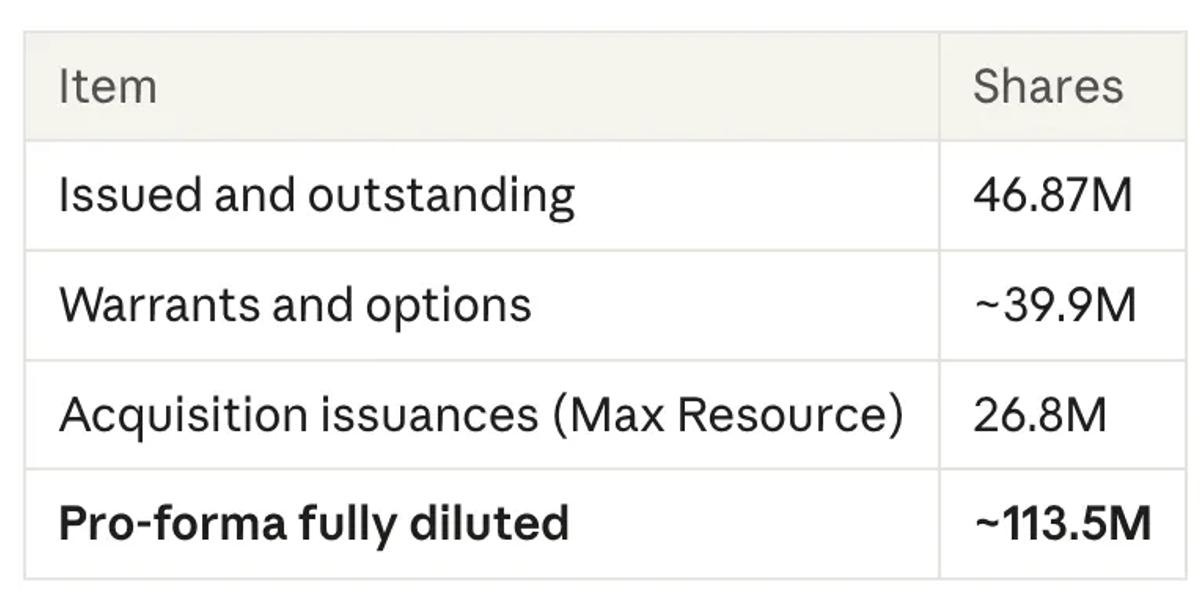
At C$0.44 (16 September), that’s ~C$20.6M basic. The company has raised more than C$10M to date.
I’ll be straight about this, because nobody else in micro-cap land is: fully diluted is more than double the basic count. At C$0.44, that’s roughly C$50M FD. The basic float is tight, and the register is held hard, which is why the stock moves when someone wants in. But the warrant overhang is real. The offset is that in-the-money warrants bring cash into the treasury as they’re exercised, funding the path to a construction decision. Watch the FD number, not just the headline cap.
Back-of-envelope, not a model
No feasibility study and no published economics. So treat this as arithmetic, not a forecast. Every US$10/t of margin is ~US$9M a year. Against a ~US$12M build and a ~C$20M market cap, the setup is asymmetric if the company delivers anywhere near plan.
What Brazilian iron ore changes hands for
Five disclosed Brazilian transactions since 2019, three of them in the last 26 months:
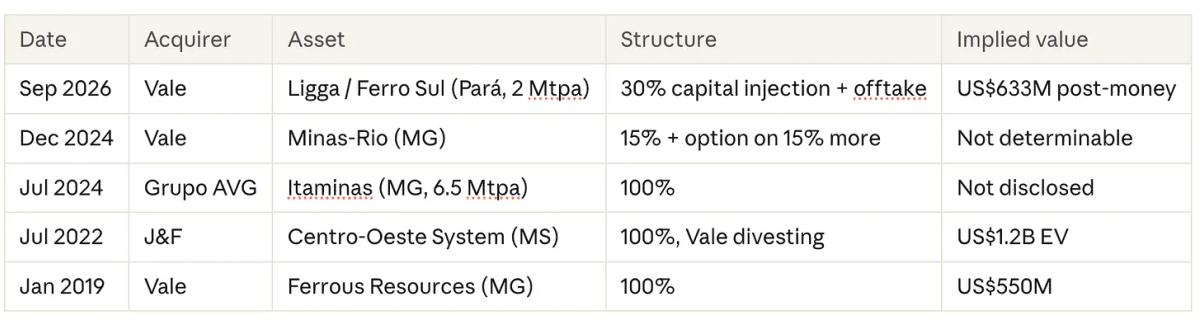
These are producing assets, so they don’t price Florália. They show an active market with multiple structures and multiple buyers, not just majors.
The more relevant comp is pre-production: Fortescue bought Red Hawk Mining (Blacksmith) in January 2025 for A$253M at a 48% premium, at the pre-feasibility stage.
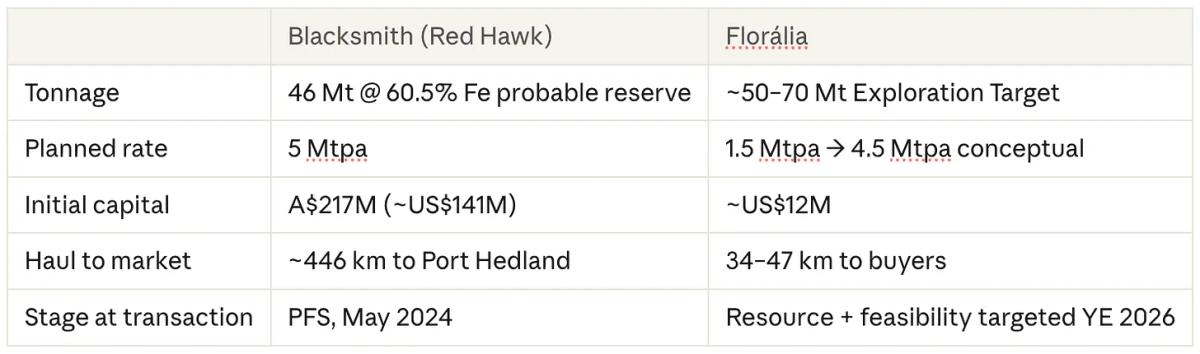
Roughly a tenth of the capital and a tenth of the haul. What Blacksmith had that Florália doesn’t yet have: a classified reserve and a study. That gap is exactly what the next twelve months are about closing.
The company states clearly that no transaction is contemplated and that it has had no discussions with Vale. I’m showing these as market context, not a price target.
The team has done this before, down the road
The hardest question for any developer is whether they can actually build. This team has answered it three times within 50 km.
- Henrique De Sales, Director and Head of Brazil Operations. Ex-Vale iron ore geologist. Developed Ferro Puro, GSM and Córrego do Onça, all hematite DSO, all within 50 km of Florália, on the same ore type.
- Zachary Kotowych, CEO. 10+ years across exploration, corporate development and mining equity research. M.Sc. Geophysics, University of Toronto.
- Brett Matich, Technical Advisor. 25+ years. Instrumental in Koolan Island Hematite DSO and taking Block 103 to a 7.8 Bt resource.
- Dr. Chris Grainger, In-Country Technical Advisor. 25+ years in South America, including Buriticá. CEO of Helius Minerals.
Catalysts, Risks, and What I’m Watching
The path to production
- Drilling and maiden resource (underway). The first NI 43-101 resource converts a conceptual target into something you can value. This is the big one.
- CENIBRA surface agreement. Finalising the landowner indemnity (Acordo de Servidão) to secure site rights.
- Environmental licence (in progress). State licensing with SEMAD in Minas Gerais. This is the critical path item.
- Feasibility study and construction decision (targeted late 2026). First published economics.
- Construction from Q3 2027. A 3–6 month modular build.
- First production (target H2 2027).
Re-rating moments, in my view: the resource, the licence, and the feasibility numbers. Any one of them narrows the gap to the Blacksmith-style comps.
What could go wrong
- No resource yet. The ~50–70 Mt is an Exploration Target. It’s conceptual, and further work may not produce a Mineral Resource at all.
- Capex is the company’s estimate. The ~US$12M is not backed by a feasibility study. Small builds have a way of growing.
- Assays are partly indicative. Some grades come from portable XRF; certified assays are pending.
- Mass recovery is not iron recovery. A 60% mass recovery means ~40% of what you dig is reject. Dry-stacked, but it’s still material to manage.
- Permitting in Minas Gerais. The no-dam, no-water design helps. Brazilian licensing timelines still slip.
- Iron ore price. China’s steel cycle sets the benchmark. Domestic mill-gate sales soften it, but they don’t remove it.
- Dilution. ~113.5M fully diluted versus 46.9M basic.
- Liquidity. CSE and OTCQB. Tight float cuts both ways.
- Execution details. No offtake signed yet, biomass supply for drying, and BRL currency exposure.
My checklist
- Maiden resource tonnage and grade versus the 50–70 Mt target.
- SEMAD licence timing.
- Feasibility capex versus the US$12M estimate.
- First offtake or mill-gate MOU.
- Warrant exercise and treasury balance.
- And on the macro side: does EWZS finally break that 2011 line?
Brazil’s large caps are telling you the regime is changing. The small end hasn’t confirmed. Florália is my bet that when it does, a near-term, low-capex, high-grade producer next door to the buyers won’t stay priced like a grassroots explorer.
DYODD.
Disclosure
I own shares of 26 Metals Inc. (CSE: IRON / OTCQB: PCRCF). I have not received, and will not receive, any compensation from 26 Metals or any third party for this coverage, and Catalystwire Communications DMCC has no advisory or consulting relationship with the company. I also hold Brazil exposure through EWZ and Petrobras (PBR). I may buy or sell any of these securities at any time without notice.
This is not investment advice. Micro-cap and pre-production mining stocks are speculative and can lose most or all of their value. Florália has no classified Mineral Resource under NI 43-101 or JORC, no feasibility study, and is not in production. Figures marked as targets or estimates are conceptual and come from the company. Do your own due diligence.
Sources: 26 Metals Investor Presentation, Florália Fact Sheet, and Florália One-Pager (September 2026), available at twentysixmetals.com. Market data as at 16 September 2026. Charts and Brazil macro commentary: Tavi Costa, Crescat Capital.
This article reflects personal research and opinions and is provided for informational purposes only. It is not financial advice, a recommendation to buy or sell any security, or a consideration of your individual circumstances. Investing in small-cap and pre-commercialization companies involves significant risk, including the risk of total loss. Always do your own research and consider speaking with a qualified financial professional before making investment decisions.
Stay Informed with The Wire
Get the latest insights and analysis on public companies delivered directly to your inbox.