The $30 Target Assumes Aduro Barely Shows Up
What the Street's most aggressive ADUR model actually bakes in, and what happens if penetration merely reaches 1%
Disclosure: I am long ADUR/ACT. I receive no compensation from Aduro Clean Technologies. This is not investment advice. Do your own work.
Yesterday, H.C. Wainwright reiterated its Buy on Aduro with a $22 target. Roth MKM has a Buy and $30. Ladenburg has a Buy and a $19 target, though that call dates from January. The stock last traded at $12.67.
On TipRanks, that works out to a $26 average across the two targets set in the past three months, roughly 105% upside. Most people see that and conclude the Street is already bullish.
I think that reads the situation backwards. When you open the most aggressive model and look at the volumes underneath it, the $30 target isn’t a bullish case. It’s close to a floor case that happens to be priced well above where the stock trades today.
What Roth actually models
Roth initiated on July 27, 2026. Its $30 target is 13.3x projected 2035 adjusted EBITDA of CAD$403.1M, discounted back to 2027 at 15%. The model runs two businesses: plastics upcycling and paraffinic crude upgrading. Heavy oil/bitumen and renewables contribute nothing.
Here are Roth’s 2035 volumes set against the size of each market:
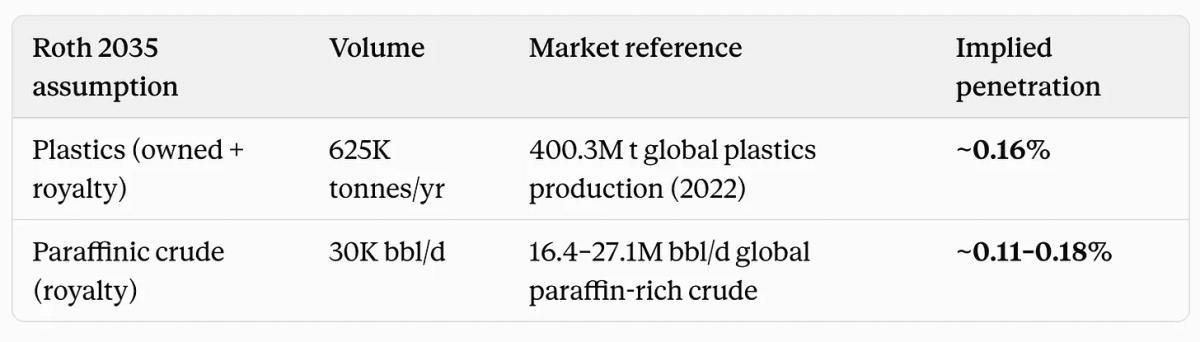
The comparison is loose, since capacity is being measured against production, but the order of magnitude isn’t in doubt. Nine years after first commercial production, Roth’s model has Aduro processing less than one fifth of one percent of either market.
The inputs are conservative too. On paraffinic crude, Roth assumes a $3/bbl royalty and says itself that the rate could be higher. Its own plant economics put the uplift to the producer at $10–13/bbl after conversion costs. On plastics, circular naphtha is priced at $1,250/t, the bottom of the $1,250–2,050/t range Roth cites. The royalty is 5% of revenue.
I’m not criticizing Roth. Sell-side analysts covering a pre-revenue company have to model what they can defend, and a 15% discount rate on a company that hasn’t built its first commercial plant is fair. The point is that the target reflects a company that commercializes and then stays small.
The paraffinic crude math
This is where the gap is largest, and where I think the market pays least attention.
Paraffinic crude is waxy. It solidifies at ambient temperature, so it needs heated transport and rail cars, and it sells at a discount. In the Uinta Basin in Utah, Roth puts that discount at around $13–15/bbl below WTI. Utah output hit a record 184.3K bbl/d in summer 2025, and takeaway capacity is roughly 180–200K bbl/d.
In April 2026, Aduro announced it had extended HCT to paraffinic crude. At bench scale, it brought pour point down to -21°C. Management describes waxy crude as effectively “liquid plastic,” meaning long paraffinic chains that the same C–C cleavage chemistry can shorten.
Roth’s 30K bbl/d by 2035 is about 15–20% of Uinta production, and zero outside Uinta. But paraffin-rich crude makes up an estimated 20–33% of global crude production. At 30K bbl/d, Aduro would have a small share of one basin and nothing anywhere else in the world.
Water Tower Research, which Aduro pays for coverage, models the same opportunity reaching ~300K bbl/d by FY35 with a $5/bbl royalty. That works out to about 1.1–1.8% of global paraffinic production. That number comes with its own caveat, which I cover below. Still, it shows how far apart two reasonable models can be on the same asset.
What does 1% look like?
I took Roth’s own framework and changed only the volumes: same multiple, same discount rate, same royalty rates, same margins. This is my arithmetic, not Roth’s, and it is not a price target. It’s a sensitivity test showing how much the $30 depends on the penetration assumption.
Plastics at 1%. 1% of 400.3M tonnes is ~4.0M tonnes, about 3.4M tonnes above Roth’s figure. Suppose every extra tonne comes through licensing at Roth’s stated terms: 5% royalty, $1,250/t naphtha, 85% yield, 95% margin. That adds roughly CAD$240M of 2035 EBITDA.
Paraffinic at 300K bbl/d. Take Water Tower’s volume but keep Roth’s lower $3/bbl royalty. The extra 270K bbl/d adds roughly CAD$400M to 2035 EBITDA.
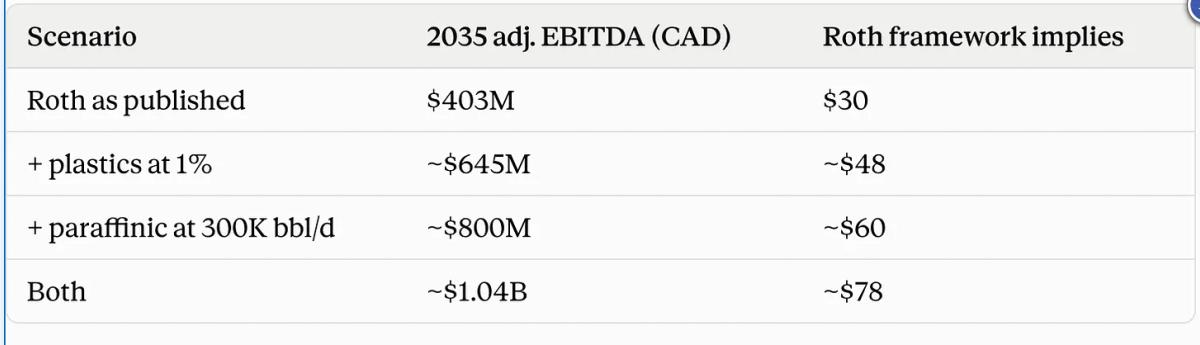
These figures assume Roth’s share count and multiple stay fixed, which won’t hold exactly. Licensing at this scale would likely need more capital and more dilution before 2035. Water Tower’s model already assumes the share count roughly doubles.
The direction is the point. Two adjustments, 1% of plastics and one basin’s worth of paraffinic crude, take the most bullish framework on the Street to more than twice its current target. Neither is heroic. There’s also no heavy oil, no bitumen, and no renewables in any of these numbers. Water Tower alone models ~550K bbl/d of bitumen royalty by FY35.
Why the Street stays conservative
The analysts aren’t making a mistake. They’re pricing the risk that exists today:
- No commercial plant yet. The FOAK plant at Chemelot is targeted for early calendar 2028 per the FY2026 MD&A, which is a slip from the earlier mid-to-late 2027 guidance. The largest continuous run disclosed so far is 47 hours on the NGP pilot, with an 86% liquid yield as reported by the company. Commercial durability is measured in months.
- Paraffinic results are bench-scale. The -21°C pour point is a laboratory result. Roth has 2030 as the earliest paraffinic revenue, and the commercial structure (royalty, build-own-operate, or partnership) isn’t decided.
- No signed commercial license. The EPC MOU and the CEP participants (Shell, TotalEnergies, Georg Fischer) are validation, not revenue.
A 15% discount rate on 2035 cash flows reflects all of that. What I want investors to notice is that the conservatism shows up twice. The discount rate already absorbs the execution risk, and then the volumes assume that even a successful Aduro stays tiny. Once the FOAK runs, the discount rate should come down. The penetration assumptions are the bigger lever, and so far nobody on the sell side has moved them.
What would change my mind?
- Scale-up failure at the FOAK. If Chemelot can’t run continuously at commercial yields, every penetration debate above is moot.
- No commercial license signed by the end of 2029. The licensing model is what makes 1% possible. Without a signed licensee, the ceiling is whatever Aduro can build with its own balance sheet.
- Repeated dilutive raises at falling prices. Capital is needed for the build-out. Raising it on bad terms would compound against shareholders.
What to watch
- FOAK FEED and groundbreaking, which is the falsifiable marker for the 2028 timeline
- Longer NGP campaigns on mixed PP/PE feedstock
- A named paraffinic crude partner or field trial beyond bench scale
- TotalEnergies’ R&D collaboration moving to a commercial-stage engagement
- Any sell-side model revision that increases volumes rather than just rolling forward the discount period
Bottom line
Every analyst covering ADUR rates it a Buy, and the average target is roughly twice the share price. That upside comes from models where Aduro takes less than 0.2% of its two primary markets and earns nothing from its other verticals.
The market is effectively being asked to pay $12.67 for a company whose most bullish Street case assumes it barely shows up. If Chemelot works, I think the debate moves from whether Aduro commercializes to how much of the market it takes. The current targets don’t cover that second question.
Disclosure: I am long ADUR/ACT and may buy or sell shares at any time without notice. I receive no compensation from Aduro Clean Technologies. Sensitivity figures are my own calculations based on Roth Capital’s published assumptions and are not price targets. Bench-scale and pilot-scale results do not guarantee commercial performance. Do your own due diligence.
This article reflects personal research and opinions and is provided for informational purposes only. It is not financial advice, a recommendation to buy or sell any security, or a consideration of your individual circumstances. Investing in small-cap and pre-commercialization companies involves significant risk, including the risk of total loss. Always do your own research and consider speaking with a qualified financial professional before making investment decisions.
Stay Informed with The Wire
Get the latest insights and analysis on public companies delivered directly to your inbox.