
The Shopify for Doctors: Why I Think Rocket Doctor AI Is the Most Asymmetric Setup in Digital Health
How a physician-built AI platform quietly finished the hard part payer contracts, credentialing, revenue operations while the market is still pricing the "before" picture.
Disclosure: I am long Rocket Doctor AI Inc. (CSE: AIDR | OTC: AIRDF | FSE: 939)
Two videos dropped in the last stretch that, taken together, tell you almost everything you need to know about this company, and they tell it from opposite ends of the table.
The first is the Rocket Doctor AI Town Hall, June 3, 2026 management’s own account, delivered by Dr. Essam Hamza (CEO of the parent company) and Dr. William “Bill” Cherniak (Founder & CEO of Rocket Doctor Inc.). That’s the inside view. Treat it as management commentary, not filed disclosure.
The second is “This AI Company Gives Doctors a Money Machine” from Amateur Investing, an outside retail analyst with no relationship to the company who builds the payer-economics case from first principles. That’s the outside view, and it’s the more interesting of the two, because it independently arrives at the same place management does.
I want to walk through what both said, separate what’s filed from what’s asserted, and then tell you where I think the market is wrong.
1. The problem isn’t money. It’s throughput.
The US spends roughly $5 trillion a year on healthcare and still leaves about 100 million people without a dedicated primary care physician. Canada leaves an estimated six million people without a family doctor (Town Hall, ~03:42). When people have nowhere else to go, they go to the ER for sore throats, UTIs, rashes, and medication refills.
Meanwhile, the supply side is drowning. Both videos land on the same number independently: physicians spend 40–50% of their working hours on paperwork, billing, and compliance rather than practicing medicine (Town Hall, 09:12; Amateur Investing, 30:32).
So you have unmet demand on one side and misallocated supply on the other, with an expensive middle layer absorbing the difference. That’s not a funding problem. That’s a routing problem, and routing problems are exactly what software solves.
2. What’s actually under the hood
I’m allergic to “AI healthcare” companies that are a GPT wrapper with a stethoscope logo. This one isn’t, and the distinction matters.
The Global Library of Medicine (GLM). Management describes it as built over seven to eight years by more than 200 practicing physicians contributing over 25,000 curated hours, mapping 17,000+ symptoms across 1,000+ diseases (Town Hall, 11:06).
It reasons rather than retrieves. The engine dynamically shifts its questioning based on patient answers, updates a differential diagnosis in real time, and can suggest labs or imaging before the physician ever joins the call (Town Hall, 11:49). Amateur Investing describes the same mechanism as Bayesian probability applied to prior clinical data (Amateur Investing, 04:11). That is a fundamentally different architecture from a model that scrapes and summarizes.
It’s been externally graded. Medical schools including the University of Minnesota have used the system to evaluate students during OSCE clinical-skills examinations (Town Hall, 14:27). Academic institutions do not put a hallucination machine in front of their licensure pipeline.
Around the GLM sits the actual product, what management calls a “Shopify-like” ecosystem for independent practice (Town Hall, 19:00), and these new features are being launched between now and the rest of the year, each of which is a new revenue engine if launched successfully:
- AI Nurse/intake: 24/7 triage, severity assessment, ER routing for genuine emergencies, pre-visit lab ordering, and booking (Town Hall, 16:48)
- AI Scribe: ambient transcription and charting, so nobody types during the visit (Town Hall, 17:34)
- Remote care hardware: Bluetooth stethoscopes and otoscopes for examination at distance (Town Hall, 19:28)
- Patient marketplace: demand delivered to the physician, so they aren’t buying ads or signing leases (Town Hall, 20:24)
- Automated billing: claims submitted and reconciled by the platform (Amateur Investing, 05:51)
The doctor logs in, sees patients, and gets paid. That’s the whole pitch, and it’s a good one.
3. The part that actually convinced me: the payer
Most digital health companies die because someone in the chain loses. Amateur Investing’s contribution, and I think this is the sharpest thing in either video, is the payer arithmetic (Amateur Investing, 20:14).
Health insurance runs on brutally thin net margins, roughly 0.4% to 1.2%. An average treat-and-release ER visit costs an insurer somewhere around $1,000. A virtual visit costs them something closer to $100–$150. His conclusion: if a payer diverts even 1% of low-acuity ER visits into virtual care, corporate net profit could move 8–10%.
Be clear about what that is. That is an independent creator’s model, not company guidance and not a figure in any filing. I have not verified his inputs. But directionally it explains something that would otherwise be strange: why national payers are signing in-network agreements with a company this small. They aren’t doing it out of charity. Virtual diversion is one of the few levers that moves a 1%-margin business.
And the patient side isn’t a compromise. Same-day, in-network, covered, from home. Amateur Investing notes Rocket Doctor’s customer reviews average around 4/5 on Trustpilot against roughly 1.2/5 for UnitedHealthcare (Amateur Investing, 25:01). Whatever you think about review-site methodology, the gap is not subtle.
4. Now the filed numbers, because this is where the thesis lives or dies
Everything above is narrative. Here is what’s actually in the Q1 2026 MD&A and financial statements filed on SEDAR, which is the only source I’ll build a position on.
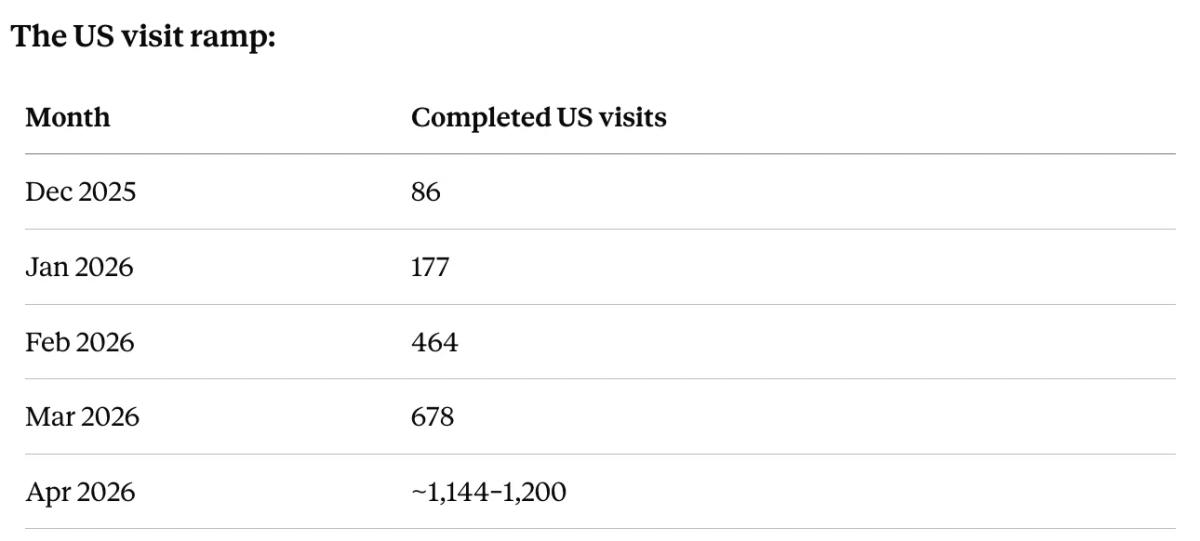
Monthly completed US visits rose 283% during Q1 2026, then another ~69% month-over-month in April (Q1 2026 MD&A). Canada, the mature business, did 47,790 completed visits in Q1 2026 against 37,176 a year earlier — still growing, but this is not where the story is.
The covered lives: approximately 21 million in-network lives across California (~8.1M), New York (~9.9M), and Maryland (~3.1M, raised to ~3.2M after an April payer addition). The MD&A states plainly that less than 3% of projected revenues associated with these payer agreements are reflected in current financial statements.
The revenue: C$737,103 in Q1 2026, up ~5% sequentially from C$697,340. That’s it. Against 21 million covered lives.
That gap — 21 million contracted lives, three quarters of a million dollars of quarterly revenue — is the entire investment thesis. Everything else is commentary.
Why the gap exists, and why I think it closes. Two reasons, and neither one is “patients don’t want this.”
- Credentialing is the binding constraint, not demand. Commercial and Medicaid credentialing runs three to six months per physician. Management reported roughly 80 active providers by end of May 2026 — double the prior count — with nearly three times that number sitting in the credentialing pipeline, acquired with effectively zero physician-marketing spend (Town Hall, 34:50). Cherniak added that not a single physician has left the US platform since launch (Town Hall, 41:36). The supply side isn’t leaking; it’s queued.
- Cash-basis government billing lags visits by 45–90 days. A visit completed in April shows up in revenue in Q2 or Q3. The reported line always trails the operating reality by roughly a quarter. If you mark the company on trailing revenue, you are marking it on a stale picture by construction.
Strategic note worth appreciating: management deliberately opened in California, New York, and Maryland first — three of the most regulatory-hostile states in the country (Town Hall, 26:30). That’s counterintuitive until you realize the playbook you build for California generalizes downward to everywhere else. They took the hardest exam first.
5. Where I’d push back on my own thesis
I own this. That obligates me to be harder on it than the bears are.
The per-visit economics don’t reconcile. Management and Amateur Investing both cite roughly US$25 per US visit (Town Hall, 27:48; Amateur Investing, 17:02). Maxim Group’s initiation note says US$18. I’ve also seen much higher per-visit figures used in penetration math floating around retail channels. Three different numbers, three different sources, and the spread is material; a 28% difference in take rate compounds hard across any volume forecast. Until this reconciles against filed disclosure, I’d describe the US opportunity as a nine-figure USD revenue opportunity at scale and refuse to be more precise than that. Anyone giving you a decimal point here is guessing.
“Minimal debt” is no longer a thing you can say. On August 6, 2026, the company closed a first tranche of unsecured convertible debentures for gross proceeds of C$2,269,000 at 12% annual interest, maturing in twelve months. Twelve percent is not cheap money. It tells you the company needed capital and chose this over an equity raise at the prevailing price. You can read that charitably (unwilling to dilute at these levels) or uncharitably (limited options). Both readings are live.
The cash burn is real. C$3.5M cash at March 31, 2026, against C$3.09M used in operating activities during Q1 alone, and a C$4.65M comprehensive loss for the quarter against C$737K of revenue. Marketing spend nearly tripled year over year to C$963K. This company is buying growth, and the runway is measured in quarters, not years.
There’s a warrant stack. Roughly 22.1 million warrants outstanding as of March 31, 2026, at a weighted average of $0.79, including ~5.2M at $0.75 expiring August 21, 2026 (that’s days from now), ~3.7M at $0.75 expiring October 2, 2026, and ~7.4M at $0.85 expiring January 22, 2027. Above strike, those are non-dilutive proceeds and a genuine reason the company is spending on investor visibility right now. Below strike, they expire worthless, and the funding question comes back. Layer the new debenture conversion on top, and you have a multi-tranche overhang that any honest bull has to hold in view.
Quality control sits outside the company’s walls. Physicians operate independently. A rude doctor or a missed appointment is Rocket Doctor’s brand damage and not Rocket Doctor’s employee (Amateur Investing, 39:42).
6. The valuation, and why I’m still here
Management pegged the market cap around C$50–60M during the town hall (Town Hall, 38:50); Amateur Investing put it near US$40M (Amateur Investing, 41:34). Meanwhile, private health-AI comparables are printing at $1B to $12B+ on far less clinical infrastructure.
I don’t put much weight on comp-table arguments; private marks are marketing documents. What I put weight on is this:
The expensive, slow, un-fakeable work is done. Payer contracts across three of the hardest states: signed. Credentialing infrastructure: built over three and a half years. Revenue operations, billing, collections: running. Physician supply: queued three-deep with zero acquisition cost. The clinical engine: eight years and 25,000 physician-hours in.
What remains is throughput. Credentialing pace, and the 45-to-90-day billing lag catching up to a visit curve that has gone from 86 to over a thousand a month in five months.
That’s my thematic filter and always has been: setups where the structural work is complete but the market is still pricing the “before” picture. This is the cleanest example of it I own.
For balance: analyst coverage exists, and both notes carry conflicts you should know about. Maxim Group rates it Buy with a C$3.00 target. Fundamental Research Corp has it Buy at C$1.86 fair value, and is paid for coverage.
7. What would prove me wrong
I’d rather name these now than rationalize later.
- Q3/Q4 revenue doesn’t inflect. If the billing lag catches up and revenue is still under C$1M a quarter with visits above 1,000/month, the per-visit economics are worse than any published figure and the thesis breaks.
- Credentialed physician count stalls. If active providers sit near 50 into Q4 while the pipeline stays “three times” that number, credentialing isn’t a queue; it’s a wall.
- Visit growth flattens before it hits meaningful scale. The ramp is off a tiny base. Compounding off 86 is easy. Compounding off 1,000 is the actual test.
- The next raise comes at a materially lower price. Another 12% instrument or a discounted equity round would tell you the debenture wasn’t opportunistic; it was necessary.
- A payer churns. Losing one in-network contract would say the ER-diversion economics don’t work the way Amateur Investing modelled them.
Q2 2026 results are the next real data point, and I’m watching them.
Sources
- Rocket Doctor AI Town Hall, June 3, 2026 — Dr. Essam Hamza & Dr. William Cherniak:
- “This AI Company Gives Doctors a Money Machine” — Amateur Investing:
- Rocket Doctor AI Inc. Q1 2026 Interim MD&A and Condensed Interim Consolidated Financial Statements (SEDAR+)
- Rocket Doctor AI Inc. news releases, July 28 and August 6, 2026 (GlobeNewswire)
- Maxim Group initiation of coverage; Fundamental Research Corp. update, both carry disclosed conflicts
Video timestamps are cited as given. Statements attributed to the Town Hall are management commentary. Statements attributed to Amateur Investing are the independent analysis of a third-party creator with no disclosed relationship to the company. Only figures attributed to the MD&A, financial statements, or news releases are filed disclosure.
Disclosure & Disclaimer
I am long Rocket Doctor AI Inc. (CSE: AIDR | OTC: AIRDF | FSE: 939), representing approximately 6% of my equity portfolio as of publication. I have not been compensated by the company or by any third party for this article. I may buy or sell shares at any time without notice or update.
This is a thinly traded micro-cap. Liquidity is poor, spreads are wide, dilution risk is real, and the company is not profitable. Nothing here is a recommendation to buy or sell anything. Everything in this piece is my own opinion and analysis, offered for informational and educational purposes only. Verify every figure against the company’s filings on SEDAR+ before you act on anything.
NFA. DYOR.
This article reflects personal research and opinions and is provided for informational purposes only. It is not financial advice, a recommendation to buy or sell any security, or a consideration of your individual circumstances. Investing in small-cap and pre-commercialization companies involves significant risk, including the risk of total loss. Always do your own research and consider speaking with a qualified financial professional before making investment decisions.
Stay Informed with The Wire
Get the latest insights and analysis on public companies delivered directly to your inbox.